How to Choose the Right Career: A Practical Guide for Students & Graduates
Someone asks, “So what are you going to do next?”
And you freeze a little. Not because you have no ideas — you probably have three or four, plus a few your parents keep suggesting, plus one you saw someone talk about on Instagram last week. The problem isn’t a lack of options. It’s not knowing how to choose between them.
If that’s where you are right now, this guide isn’t going to hand you a list of “best careers” and send you off. It’s going to walk you through how to choose the right career — a process you can actually reuse, whether you’re picking a stream after 12th, a job after graduation, or rethinking everything five years into a career that isn’t working.
By the end, you won’t necessarily know your exact career. But you’ll know how to figure it out.
Quick Answer: How Do You Choose the Right Career?
Choosing the right career means finding the overlap between what you’re genuinely interested in, what you’re good at (or willing to get good at), what the market actually pays and hires for, and the kind of life you want to live. No single factor — not passion, not salary, not prestige — is enough on its own.
The practical process: list your interests and strengths, identify a few realistic directions, research the real day-to-day work and required skills, test one direction through a small project or internship, then decide and reassess. Career decisions aren’t permanent verdicts — they’re informed first steps you’re allowed to adjust.
What Does It Actually Mean to Choose the “Right” Career?
“Right” doesn’t mean the highest-paying option. It doesn’t mean the most prestigious degree, the most talked-about field, or the safest government job your relatives approve of. Any of those could be right for you — but only if they also fit how you think, what you’re capable of doing well, and how you want your day-to-day life to look.
A career is “right” when it satisfies three things reasonably well at the same time:
- You can do the work (or can realistically learn to).
- Someone will pay you to do it (real, current demand — not hype).
- You can live with doing it (the actual daily grind, not the Instagram version).
Very few careers score a perfect 10 on every factor. The goal isn’t perfection — it’s a strong, honest overlap.
What Should You Consider When Choosing the Right Career?
Career decision-making gets easier once you stop treating it as one big question and start treating it as seven smaller, answerable ones.
1. Interests
What you’re interested in matters because you’ll spend more waking hours on this than on almost anything else. Interest doesn’t have to mean “burning passion” — even mild, consistent curiosity is a strong signal.
Example: If you keep gravitating toward numbers, patterns, and “why did this happen” questions, fields like data, finance, or research may hold your attention longer than something visually creative, even if the creative field looks more exciting from outside.
Ask yourself: What do I read about, watch, or get pulled into even when nobody’s making me?
2. Strengths and abilities
Interest tells you what to explore. Strength tells you where you have a real head start. These aren’t always the same thing — you can be interested in something you’re currently mediocre at, and good at something you find a bit boring.
Example: Someone might love public speaking but be genuinely stronger at structured writing. Both can lead to good careers, but the path and pace will differ.
Ask yourself: What do people consistently ask for my help with?
3. Skills you’re willing to learn
Very few careers only need existing strengths — most need new skills you’ll build over months or years. This factor is less about “what can I already do” and more about “what am I willing to put in real effort to learn.”
Example: You may not know coding today, but if you’re willing to sit through a few months of structured learning and practice projects, a tech-adjacent career opens up regardless of your current skill level.
Ask yourself: What skill gap am I actually willing to close, versus one I’m just hoping to skip?
4. Job opportunities and market demand
A career can be interesting and suited to your strengths and still be a poor practical choice if very few organisations are hiring for it, or if the field is shrinking. This isn’t about chasing trends — it’s about checking that real, ongoing demand exists.
Example: Before committing to a niche specialization, check actual job postings on platforms like the National Career Service portal or LinkedIn to see how many current openings exist, and at what experience level.
Ask yourself: Are people actually being hired for this role right now, not just five years ago?
5. Salary and earning potential
Salary matters — anyone who tells you otherwise probably isn’t paying your bills. But it’s one input among several, not the deciding one (more on this below).
Ask yourself: Does this career’s realistic starting and mid-career salary support the life I want, even if it’s not the highest-paying option out there?
6. Career growth
Some careers have a clear, well-defined growth ladder. Others plateau quickly or depend heavily on constant reinvention. Growth also isn’t just “promotions” — it can mean expanding skills, responsibility, or independence.
Ask yourself: What does someone doing this job look like in 10 years — and am I okay with that picture?
7. Lifestyle and work environment
This is the factor people skip most often, and regret skipping the most. Work environment includes things like: fixed hours vs. unpredictable ones, remote vs. on-site, high travel vs. none, solo work vs. constant collaboration, and how much stress is “normal” for that field.
Ask yourself: What kind of week am I picturing — and does this career actually produce that week?
How Do You Know If a Career Is Right for You?
You’ll rarely get a lightning-bolt moment of certainty. Instead, look for smaller, more reliable signs:
- You can describe the actual day-to-day work, not just the job title, and it still sounds okay to you.
- The skills required overlap meaningfully with things you’re either good at or genuinely willing to learn.
- You’ve done a small taste of the work (a project, internship, or course) and didn’t dread it.
- The trade-offs — the pay, the hours, the pace of growth — feel acceptable, not just tolerable “for now.”
- You’re choosing it because of what you’ve learned about the work, not because someone else picked it for you.
No career will satisfy every single preference. Even people who love their jobs will tell you there are parts they’d change if they could. Fit is about the overall balance, not a flawless match.
How to Research a Career Before Choosing It
Most career confusion isn’t really indecision — it’s a lack of real information. Here’s a practical way to close that gap:
- Read real job descriptions for the role, not just the job title, on sites like LinkedIn or Naukri.
- Identify the required skills listed across multiple postings for that role — patterns will emerge.
- Understand day-to-day responsibilities, not just the impressive-sounding parts.
- Research entry-level roles specifically, since your first job will look very different from a senior professional’s.
- Talk to actual professionals in that field — even a 15-minute conversation beats hours of scrolling.
- Try a beginner project related to the field to see how the actual work feels.
- Take an introductory course to test your interest before committing years to it.
- Look for internships or practical exposure, even short or unpaid ones, for real signal.
- Research realistic salary and growth using current job listings, not outdated blog posts.
- Reassess after gaining exposure — your opinion after trying something is more reliable than your opinion before.
How to Compare Different Career Options
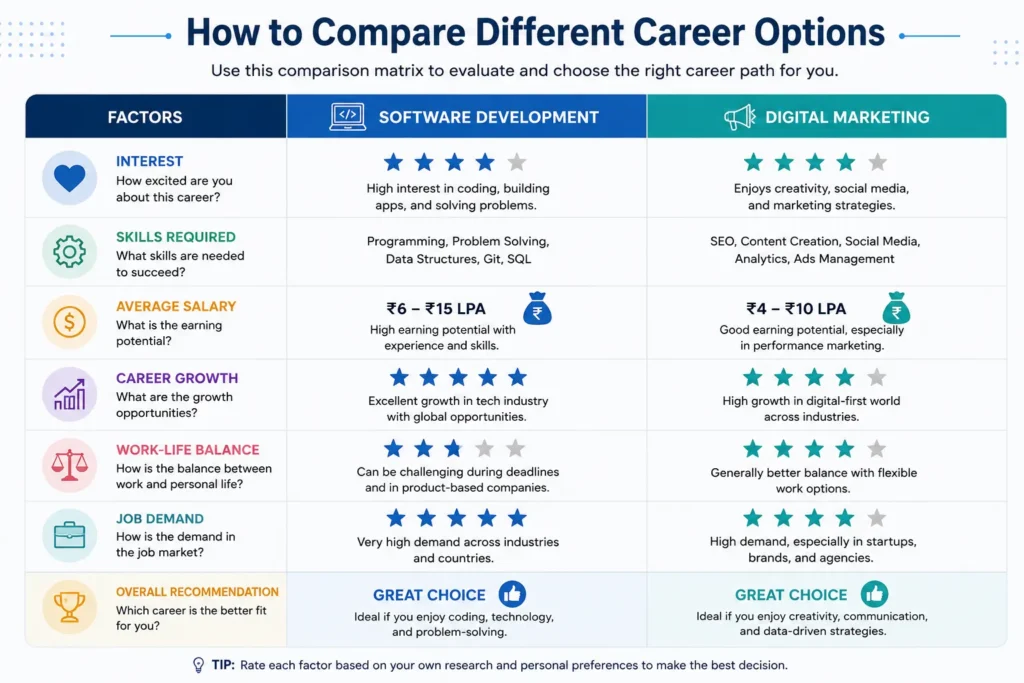
Once you’ve narrowed things down to two or three realistic directions, a simple comparison table can make the trade-offs visible instead of just swirling around in your head.
| Factor | Career Option A | Career Option B | Career Option C |
| Interest level | |||
| Matches my strengths | |||
| Skills required | |||
| Learning effort needed | |||
| Current job opportunities | |||
| Realistic starting salary | |||
| Long-term growth | |||
| Lifestyle / work environment |
How to read this table: Don’t just add up scores and pick the highest total. A career that scores slightly lower overall but strongly on the two or three factors that matter most to you personally (say, lifestyle and interest) may be a better real-world choice than one that scores evenly across the board. The table’s job is to make trade-offs visible — the decision is still yours to weigh.
Should You Choose a Career Based on Salary?
Salary should absolutely be part of the decision — it’s not something to feel guilty about considering. But treating it as the only factor tends to backfire, because a high salary attached to work you find draining or misaligned with your strengths is hard to sustain over a full career.
At the same time, “follow your passion” as standalone advice isn’t sufficient either. Passion without market demand, without a realistic income, or without the skills to actually deliver good work can leave you interested but unemployable.
The more reliable approach: treat salary as one weighted factor alongside fit, opportunity, required skills, and growth — not the tiebreaker that overrides everything else.
How to Choose a Career After 12th
This decision in India tends to carry extra pressure — from family, from peers, from the stream you already picked in Class 11. But the same process applies, just adapted to where you are.
Start with your interests and strengths as they show up in real subjects and activities, not just marks. Your stream and academic background matter, but they don’t have to be a life sentence — plenty of people move between commerce, science, and humanities-adjacent careers over time.
Then look at courses and qualifications realistically: what degree or diploma does the career actually require, how long does it take, and what does it cost — both in money and in years. Check the career opportunities attached to that qualification, not just the qualification’s reputation. Consider the skills required beyond the degree itself, since many careers now expect practical skills a degree alone won’t teach.
Finally, weigh lifestyle and long-term growth honestly. A prestigious course that leads to five more years of exams and uncertain placement may suit one person and completely drain another.
[Internal Link: Career Options After 12th]
How to Choose a Career After Graduation
After graduation, the decision usually isn’t “which career” anymore — it’s “which path into or within a career.” The common options:
- Getting a job — fastest path to income and real-world experience, useful when you want to test a field before specializing further.
- Developing a specialized skill — worth it when a specific, in-demand skill clearly unlocks better roles in your chosen direction.
- Professional certifications — useful for regulated or credential-heavy fields (finance, project management, data) where certification is expected.
- Higher education — makes sense when the career genuinely requires an advanced degree, not as a default “buy more time” decision.
- Switching fields entirely — reasonable if your research shows your current path doesn’t fit, but should follow the same research-and-test process, not a sudden leap.
- Freelancing or independent work — viable once you already have a marketable skill and can handle inconsistent income in the early stages.
Evaluate each option the same way you’d evaluate a career: what does it cost in time and money, what does it realistically lead to, and does it fit the skills and interests you’ve already identified.
[Internal Link: Career Options After Graduation] [Internal Link: Skills to Learn After Graduation]
What If You Still Don’t Know What Career to Choose?
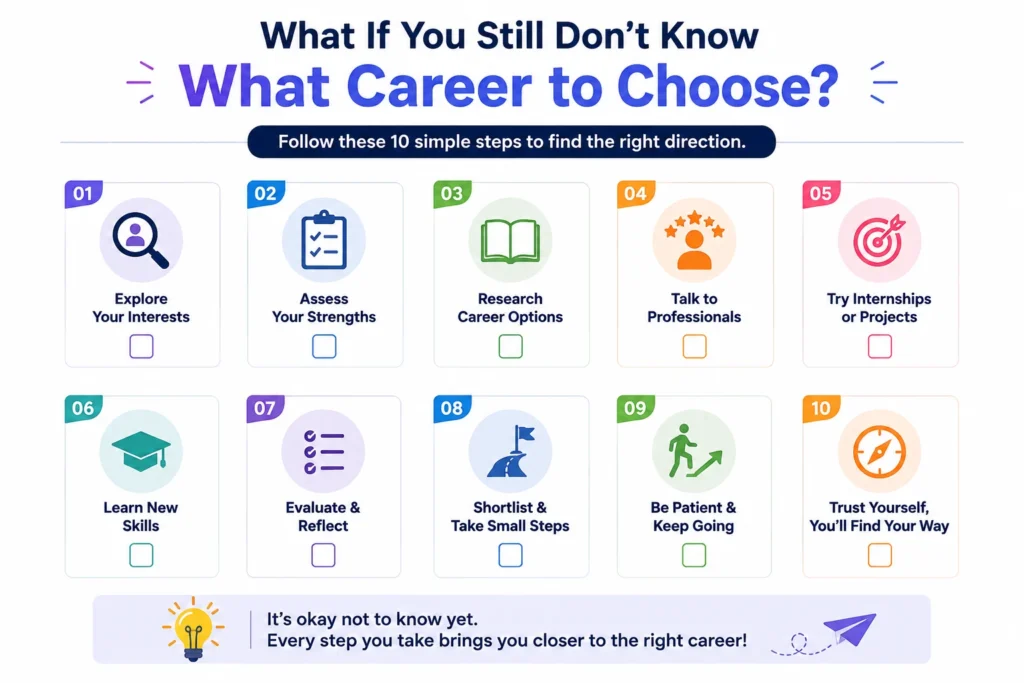
This is normal — genuinely. Most people don’t have a defined “calling.” Here’s a practical way through it:
- Stop looking for one perfect answer. There likely isn’t a single correct career waiting to be discovered.
- List your interests and strengths honestly, without filtering for “practicality” yet.
- Identify 3–5 possible career directions based on that list.
- Research the actual work for each, using real job descriptions.
- Identify required skills for each direction.
- Test one option through a project, short course, or internship.
- Speak with someone doing the work to check your assumptions against reality.
- Reflect on what you learned — did the work energize you, or did it feel forced?
- Narrow your choices based on that real feedback, not just theory.
- Make a first decision and review it later. Treat it as a strong first step, not a permanent identity.
You’re allowed to choose, work in a field for a while, and adjust. That’s not failure — that’s how most real careers actually develop.
Common Career-Choice Mistakes
Watch out for these patterns, all of which are easy to fall into without noticing:
- Choosing only because of salary, without checking if the work itself is sustainable for you.
- Following friends into the same field or course.
- Following family pressure without doing your own exploration first.
- Choosing based on prestige rather than actual fit.
- Choosing only because something is trending on social media or in conversation.
- Ignoring required skills — assuming interest alone will carry you.
- Ignoring lifestyle — underestimating how much hours and environment affect long-term satisfaction.
- Assuming a degree guarantees a career rather than researching actual hiring patterns.
- Treating personality tests as absolute answers rather than one input among many.
- Believing the first career decision must be permanent — it rarely has to be.
Can Career Tests Help You Choose a Career?
Career tests and personality assessments can be genuinely useful — for self-reflection, for surfacing directions you hadn’t considered, and for understanding your own working preferences more clearly.
What they shouldn’t do is make the decision for you. These tests work off a limited set of questions and can’t account for the specifics of your skills, your local job market, your financial situation, or how you’ve actually felt doing real work in a field. Use them as one input for exploration, not a verdict.
A Simple Career Decision Framework
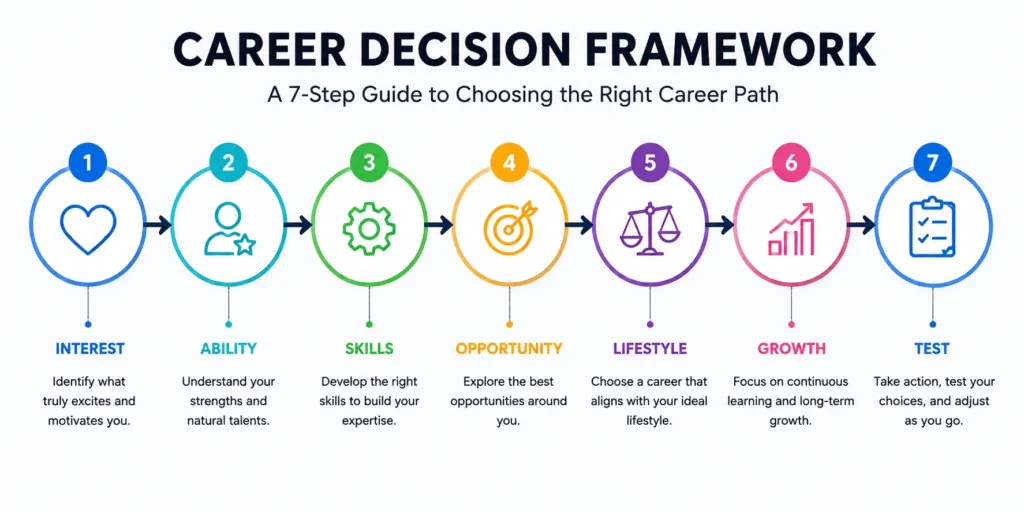
If you remember nothing else from this article, remember this sequence:
INTEREST → ABILITY → SKILLS → OPPORTUNITY → LIFESTYLE → GROWTH → TEST
- Interest — What genuinely holds your attention over time?
- Ability — What are you naturally decent at, or clearly capable of getting good at?
- Skills — What specific, learnable skills does this direction require, and are you willing to build them?
- Opportunity — Is there real, current hiring demand for this?
- Lifestyle — Does the day-to-day reality of this work fit the life you want?
- Growth — Where does this realistically lead in 5–10 years?
- Test — Before fully committing, try a small, real version of the work.
Run any career option through these seven stages, and you’ll usually know within a few weeks whether it deserves more of your time — or whether it’s time to test a different direction.
[Internal Link: Digital Marketing as a Career]
Frequently Asked Questions
How do I choose the right career?
Look for the overlap between your interests, your strengths and skills, real market demand, salary, growth, and the lifestyle you want. No single factor decides it alone.
How do I know which career is right for me?
You’ll notice signs of fit rather than certainty: the actual day-to-day work sounds acceptable to you, the required skills feel learnable, and a small taste of the work (project, internship) didn’t put you off.
What should I consider before choosing a career?
Interests, strengths and abilities, skills you’re willing to learn, job opportunities, salary, career growth, and lifestyle — together, not in isolation.
Should I choose a career based on salary?
Salary should be a factor, but not the only one. A high-paying career that’s a poor fit for your strengths or lifestyle is hard to sustain long-term.
Should I follow my passion?
Passion helps, but on its own it isn’t enough. Pair it with real skills, market demand, and realistic income expectations.
How do I choose a career after 12th?
Start from your interests and strengths, check the courses and qualifications each path requires, research actual job opportunities linked to that qualification, and weigh the cost, time, and lifestyle involved.
How do I choose a career after graduation?
Decide between a job, a specialized skill, certifications, higher education, or independent work by evaluating what each realistically leads to, given your goals and finances.
What should I do if I don’t know what career to choose?
List your interests and strengths, shortlist 3–5 directions, research each one properly, test one through a real project or internship, then make a first decision you can revisit later.
Can career tests help me choose a career?
Yes, as a tool for self-reflection and idea generation — but not as a final answer. Combine results with real research and hands-on testing.
Can I change my career later?
Yes. Most people adjust their career direction at least once. A first career choice is a strong starting point, not a lifetime contract.
[Internal Link: Don’t Choose a Career Based on Salary Alone]
Key Takeaways
- There’s no single “right” career waiting to be discovered — there’s a strong, honest overlap between interest, ability, opportunity, and lifestyle.
- Salary matters, but it works best as one factor among several, not the deciding one.
- Real research — job descriptions, conversations with professionals, small projects — beats guessing every time.
- A comparison table helps make trade-offs visible instead of letting them swirl around in your head.
- The framework Interest → Ability → Skills → Opportunity → Lifestyle → Growth → Test gives you a repeatable way to evaluate any option.
- Career tests can help you reflect, but shouldn’t make the decision for you.
- Your first career decision doesn’t have to be your last one — it just has to be informed enough to move forward.