What should I do next? This question might be triggering you after completing 10th or 12th. Believe me, you are not alone; many students are feeling the same as you.
Career planning means thinking about your future with a calm mind. For this, you have to understand your interest base, skills, and the money you can spend on it. All this matters. Remember not confuse your career with a degree, it’s actually about creating a life that gives you both satisfaction and financial security.
And never take decisions under pressure, pressure from your parents, friends, and society because that’s you who are going to work for it not anyone else going to do it, so choose your career path wisely.
In this guide, we will understand what career planning really is, why it is so important, and how you can plan your future step by step after 10th and 12th.
What Is Career Planning?
Career planning is the process of choosing the right career path by matching your skills, interests, and future opportunities.
More simply, career planning is a decision that is taken thoughtfully by knowing your strengths, finding areas that you find more interesting, and aligning them with available career options, so you can choose what suits you best.
Well, this is not one day process; it would take some time as students move from school to college, then to their job, and through this whole process situation may demand some changes. So, stay dedicated to your dream job or goal and work consistently for it with small changes in it for better opportunities.
Why Is Career Planning So Important?
Many students ask, “Why is career planning so important?”
So, here is the step-by-step answer to this question that explains the advantages of career planning:
- Saves Time and Money: Without planning, you might be distracted and confused between options. But with the right planning, you can save both time and money.
- Builds Confidence: Confidence grows as knowledge increases, so choose your goal, stay focused with it from day one.
- Better Job and Salary Growth: Planned careers have more chances to get better opportunities at an early stage in comparison to those who have done 2-3 courses and then find the right fit for them.
- Clear Future Direction: You know what to study, what skills to learn, and what job to aim for.
In short, career planning gives your life a clear direction instead of confusion.
Career Planning After 10th: Stream-Wise Guide
After finishing 10th class, students face their first big career decision—choosing the right stream. This choice plays a major role in shaping your future. Below is the stream-wise guidance:
1. Science Stream (PCM / PCB)
Choose Science if:
- You like Maths, Physics, Biology, or Chemistry
- You are interested in technology, medicine, research, or innovation
Career options:
- Engineering (Computer, Mechanical, Civil, AI, Data Science)
- Medical (Doctor, Dentist, Pharmacist, Physiotherapist)
- Biotechnology, Forensic Science, Research
- Defence, Aviation, Space Science
2. Commerce Stream
Choose Commerce if:
- You like numbers, business, finance, economics
- You are interested in management, accounts, or entrepreneurship
Career options:
- CA, CS, CMA
- BCom, BBA, MBA
- Banking, Finance, Investment, Digital Marketing, Business Analytics
3. Arts / Humanities Stream
Choose Arts if:
- You like creativity, social studies, psychology, language, or public service
- You are interested in law, media, teaching, or government jobs
Career options:
- Law, Journalism, Mass Communication
- Psychology, Social Work, Teaching
- Civil Services, Design, Content Writing, Public Policy
Career Planning After 12th: Course & Career Mapping
Like 10th-grade students, 12th-grade students do feel the same career confusion, but this time it is not for stream selection, but even bigger. At this stage, they have endless career opportunities, and they have to make a wise choice. This is where proper career planning becomes very important.
Step 1: Understand Your Stream & Interest
Ask yourself:
- Do I enjoy theoretical study or practical work?
- Do I want a professional degree or a skill-based course?
- Am I preparing for government jobs or private sector?
Step 2: Choose the Right Type of Course
1. Professional Courses
- CA, CS, CMA
- Engineering, Medical
- Law, Architecture, Design
These are long-term but high-value careers.
2. Degree Courses
- BCom, BBA, BA, BSc
Good for building a strong academic base.
3. Skill-Based & Digital Courses
- Digital Marketing
- Data Analytics
- Graphic Design
- Content Writing
- AI & Automation
These are future-ready and job-oriented.
How Do You Plan to Achieve Your Career Goals?
Many students ask in interviews and in life also:
“How do you plan to achieve your career goals?”
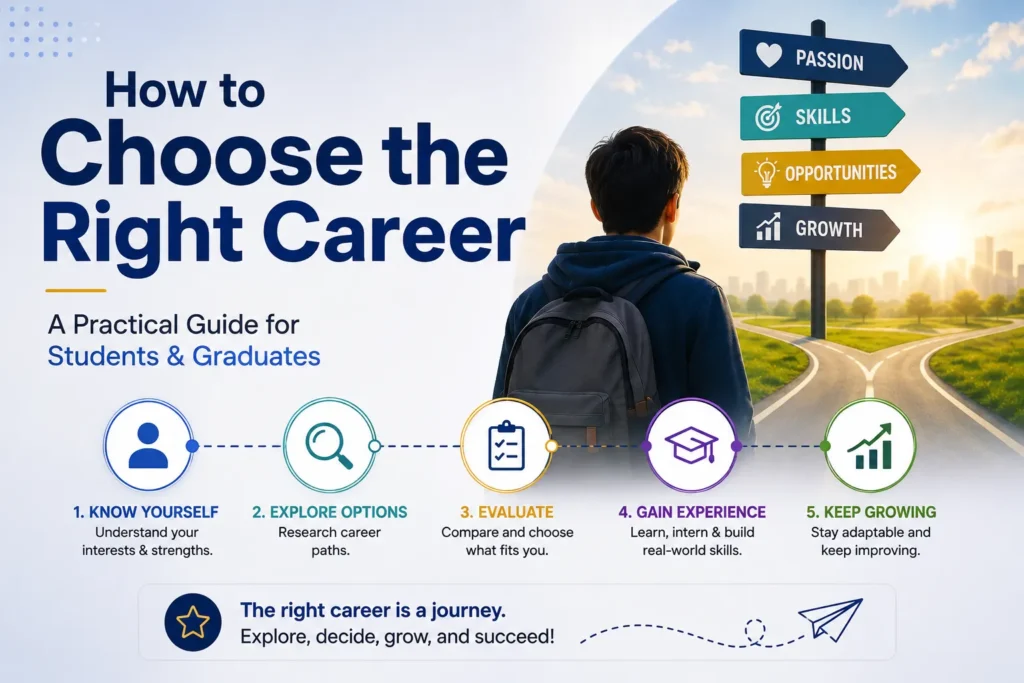
Here is a simple step-by-step method:
- Self-Assessment: Know your strengths, weaknesses, interests, and personality.
- Career Research: Study different careers, salaries, future scope, and work-life.
- Set Clear Goals: Short-term: Which course? Which college? And Long-term: Which job? Which position?
- Skill Development: Learn communication, digital skills, and practical tools.
- Right Education Path: Choose the right course, institute, and certifications.
- Experience & Exposure: Internships, projects, freelancing, part-time work.
Smart career planning turns your dreams into reality, so you must do this.
Which Career Is Best in 2026?
This is where the question “Which career is best in 2026?” comes in. Here are some listed career options you can go for:
High-Growth Career Fields
- Artificial Intelligence & Data Science
- Digital Marketing & Content Creation
- Cybersecurity & Cloud Computing
- Healthcare & Biotechnology
- Finance, Investment & FinTech
- Government Services
- Design, Media & Psychology
- Entrepreneurship & Startups
Common Career Planning Mistakes Students Make
Avoid these mistakes:
- Selecting only based on salary and ignoring interest
- Not researching future scope
- Depending only on parents’ and friends’ decisions
- Not having a backup plan
- Not upgrading skills regularly
Conclusion
Lastly, I would like to wrap it up by saying that don’t copy others, instead find your own path that is best for you. No matter if you are in 10th, 12th, or doing graduation, never regret the choices you have taken in the past; you can still correct them. We are not making rockets, so be calm in every situation and before making any decision, think clearly and wisely. Through this blog, I tried to help you with career planning and hope that you have found it helpful.